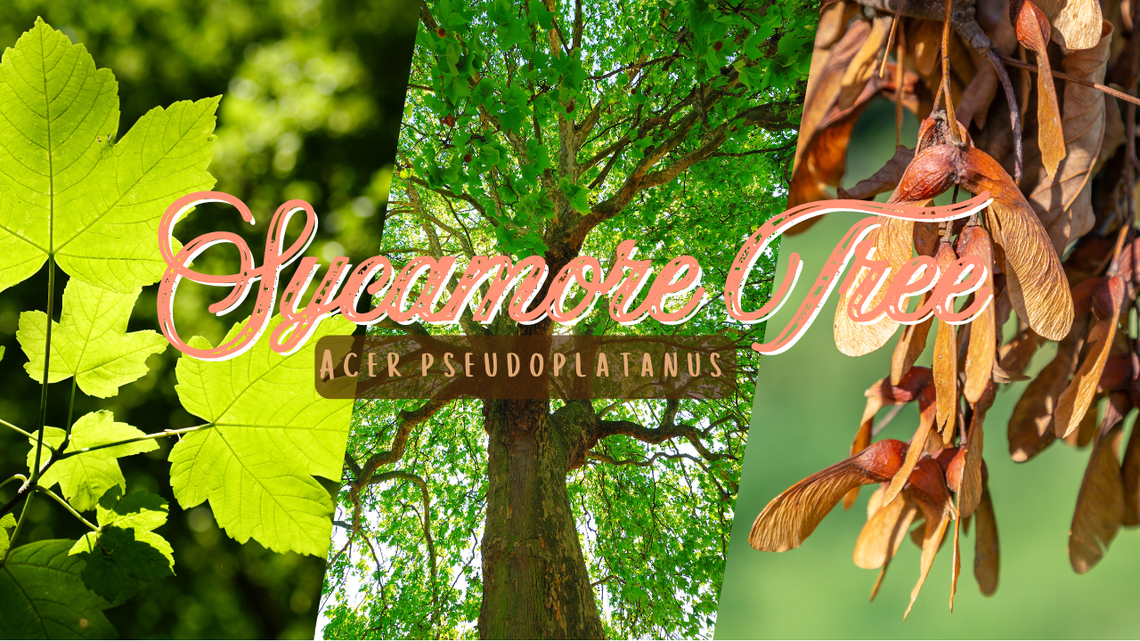
The Sycamore Tree
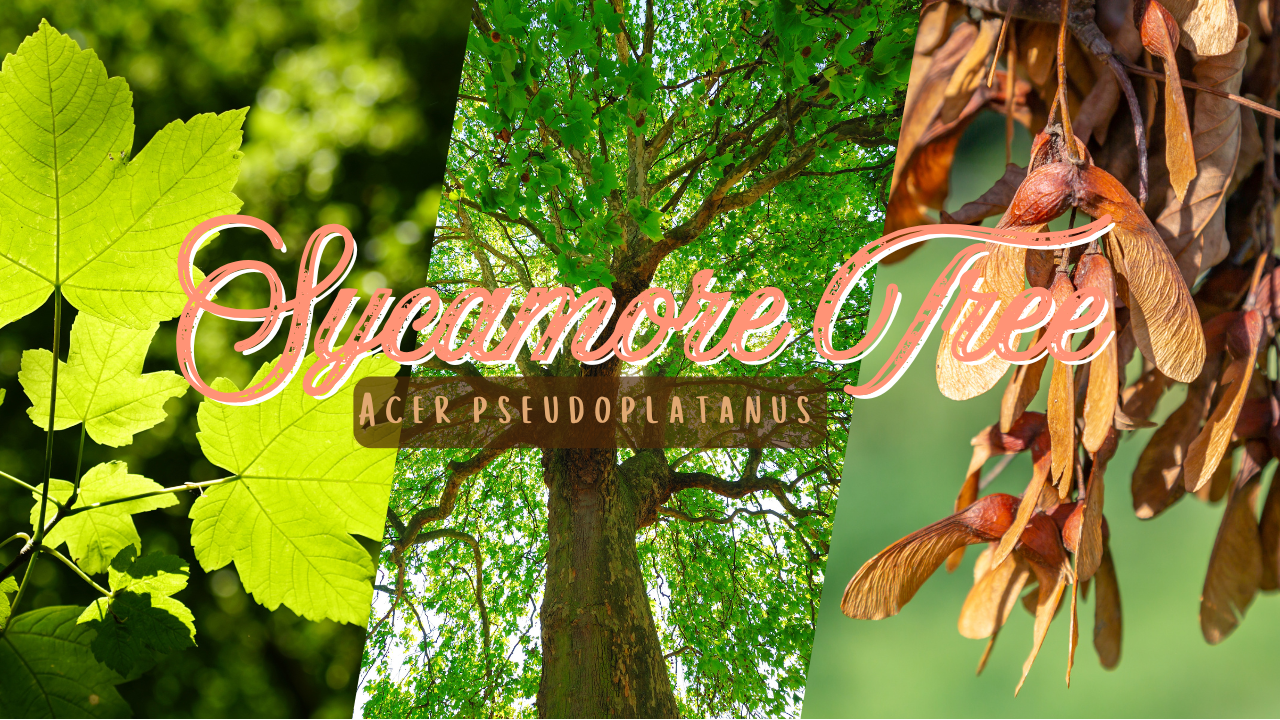
Sycamore (Acer pseudoplatanus)
The Sycamore tree is an astoundingly beautiful large tree related to the maple. It is said to inspire spiritual growth and transformation. The tree is certainly one that touches people in different ways. Its large, widespread crown with a dense supply of large leaves makes it a perfect home for insects. The trunk sometimes hollows out, which makes for ideal homes for owls and other large birds. You can recognise it by its 5-lobed, maple-like leaves and its winged seedpods.
When someone cut down the Sycamore tree of Sycamore Gap (UK), there was a public outcry. A beautiful tree in just the right place, known from the film Robin Hood: Prince of Thieves 1991. A tree that in 2016 had won the England Tree of the Year award. The National Trust grew 49 saplings from seeds collected from the tree, each of those representing a foot of the tree’s height. These have now been planted in different locations all over Britain.
The original tree stump isn’t completely dead; you can see healthy new growth around it. The Sycamore tree is suitable for coppicing, which means you can cut it down and it will regrow, very slowly, but it will most likely come again. It will take roughly 150 years to grow to its former size.

The darker side
There is, though a dark side to this tree. Its seedpods and saplings contain the poison hypoglycin, HGA, which is highly poisonous mainly to horses but also to sheep and cattle. The outcome is often death, with a mortality rate of between 50% and 80%. It strikes very quickly, and it may only take 24 hrs from the onset of the symptoms until the animal is dead.
It may look like colic with belly pain, but significantly, the animal may still eat. The poison works by eliminating energy production for the muscles. The muscles turn weak and trembly and the animal may be unable to stand.
Teagasc, the Irish Agricultural and Food Agency, recorded 200 equine deaths due to Sycamore poisoning in the very wet year of 2014. They are even going as far as to recommend the removal of Sycamore trees in conjunction with fields used for grazing. If you have affected fields, you can also choose not to use them during autumn and spring when the seeds fall and the saplings grow. Or pick the seedpods as they fall in autumn; this would entail scanning a circle with a radius of 35m from the tree. And again, look for saplings in the spring.
It is also important to bear this in mind when producing haylage, as saplings, seedpods, as well as leaves contain this poison, and it is preserved in the haylage. The leaves are less attractive to eat from the ground, but in haylage they may well be devoured.
Bearing the sycamore’s great ability to reproduce in mind, maybe we should refrain from planting this tree on land used for grazing and keep it as an ornamental tree in cities where its exceptional resilience is a bonus feature.
Is Sycamore a native species?
No, this tree was imported and first introduced to Britain during the Roman period as a parkland tree. It was viewed as naturalised in 1578. In Ireland, it was introduced somewhat later, in the 17th century.
It has since spread on an almost invasive scale and often grows in hedgerows and coppices. A lot of the time, replacing Ash that has succumbed to ash dieback.
Folklore
As the tree was imported to the British Isles, most connections to folklore stem from other cultures. There may, though, have been some confusion regarding the species. In the Bible, there are references to the sycamore fig, an entirely different tree with a similar name. The tree was meant to offer protection; hence it was often planted near churches and graveyards. One such tree is St. Fiontan’s Tree, also known as the money tree. It stood near the site of an old Monastery. It, though, succumbed to a storm in 1994.
Other ways to enjoy the tree
Woodworking
Sycamore is traditionally used for making furniture and kitchen utensils. The wood has no taste, so it works well for spoons, ladles, and cutting boards. Its strength and suppleness are also greatly appreciated by musical instrument makers.
Painting
My favourite way to enjoy the Sycamore tree is to use its leaves as templates for a brightly coloured autumn painting. Perfect as an illustration in a journal or scrapbook. It is also a great therapeutic exercise, to calm the mind. The exercise is also great for that all-important hand-brain connection.
Pick some beautiful leaves in a few different sizes. If you are not ready to use them straight away. I would advise you to press them in a book or flower press. Otherwise, they will curl up when drying.
Place the leaf on the paper and outline. Colour the leaf in a lighter shade of autumn. Continue to outline the leaves now partially hidden by the leaves you drew first. Colour in each layer a slightly darker tone. For this exercise, I would choose yellows, oranges, reds and browns,. You can of course use any colours you like.
Shade the remaining spaces in a very dark brown or even grey, almost black.


